Clarke County Dog Registration Information
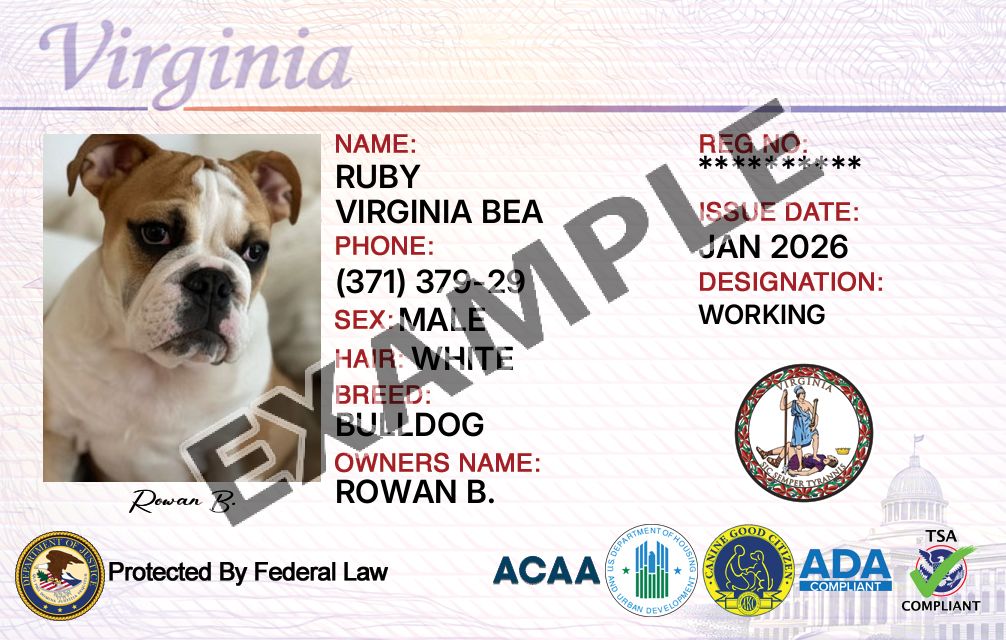
Service Dogs and Emotional Support Animals in Clarke, Virginia
If you’re asking, “where do I register my dog in Clarke County, Virginia for my service dog or emotional support dog?” the key point is this: in Clarke County, “registering” usually means getting a dog license in Clarke County, Virginia through the local government (not through a private company). Service dogs and emotional support animals (ESAs) are handled very differently under the law, and neither status replaces local licensing requirements.
This page explains where to register a dog in Clarke County, Virginia, what paperwork you may need (especially rabies vaccination proof), and how local licensing connects with animal control and rabies enforcement.
Where to Register or License Your Dog in Clarke County, Virginia
Dog licensing is typically handled locally. In Clarke County, the official point of purchase for dog licenses is the county Treasurer’s Office, and animal shelter/animal control functions are managed through county and local public safety resources. The offices below are official examples within Clarke County, Virginia (and related local enforcement points within town limits), shown exactly as published when available.
Primary Licensing Office (County)
| Office | Clarke County Treasurer’s Office |
|---|---|
| Address | 101 Chalmers Ct., Suite B |
| City / State / ZIP | Berryville, VA 22611 |
| Phone | (540) 955-5160 |
| treasurer@clarkecounty.gov | |
| Office hours | Not listed on the referenced licensing page |
Note: Clarke County’s dog licensing instructions state licenses are available through the Treasurer’s Office and can also be purchased by mail with payment and a current rabies certificate. (Official county licensing page.)
Animal Shelter (County Resource)
| Office | Clarke Animal Shelter (Clarke County) |
|---|---|
| Address | 225 Ramsburg Lane |
| City / State / ZIP | Berryville, VA ZIP not listed in referenced source |
| Phone | (540) 955-5104 |
| animalshelter@clarkecounty.gov | |
| Office hours |
Mon, Tue, Thu: 10:30 a.m. – 4 p.m. Fri: 11 a.m. – 6 p.m. Sat: 10 a.m. – 4 p.m. Closed: Sun, Wed, holidays |
Note: The shelter is a county-managed resource and a common point of contact for stray intake and related animal services information.
Local Enforcement Contact (Town Limits)
| Office | Town of Berryville Police Department (Animal Control – Dogs) |
|---|---|
| Address | 101 Chalmers Court |
| City / State / ZIP | Berryville, VA 22611 |
| Phone | (540) 955-3863 |
| Not listed in referenced source | |
| Office hours | Monday – Friday: 9:00 a.m. – 5:00 p.m. (except holidays) |
| Non-emergency | (540) 955-1234 |
Note: The Town of Berryville states that dog owners must obtain and display a license issued by Clarke County, even within Town limits.
Overview of Dog Licensing in Clarke County, Virginia
What “registering your dog” usually means
In everyday conversation, people often say “register my dog,” especially when they have a service dog or emotional support dog. In Clarke County, Virginia, the practical meaning is almost always the same: you’re obtaining a county-issued dog license (also called a dog tag). This is a local government requirement for certain dogs (commonly based on age) and is closely connected to rabies vaccination compliance and identification if a dog is found loose.
Local licensing vs. “service dog registration”
Clarke County dog licensing is not the same thing as “registering a service dog.” In the United States, a service dog’s legal status is not created by a county-issued registration card or a paid online registry. Instead, the dog is a service animal when it is trained to perform tasks for a person with a disability and meets legal definitions under applicable disability laws. Even so, your dog can still need a dog license in Clarke County, Virginia like any other dog, because licensing is about local compliance (rabies, identification, and local ordinances).
Rabies vaccination is a core requirement
Virginia law ties dog licensing to proof of rabies vaccination: local licensing officials generally cannot issue a license tag without satisfactory evidence the dog has been vaccinated against rabies. This is one reason people may hear about licensing shortly after a rabies vaccination—vaccination reporting can prompt a reminder or application process depending on how local systems are managed.
How Dog Licensing Works Locally in Clarke County, Virginia
Step-by-step: getting a Clarke County dog license
- Confirm your dog meets the county’s licensing threshold. Clarke County’s published guidance states that dogs 4 months and older must be licensed and wear tags.
- Gather your required documents. You should be prepared to provide current rabies vaccination proof. Clarke County’s licensing instructions also indicate owners need to submit proof the animal is vaccinated against rabies and is spayed/neutered.
- Purchase the license from the local issuing office. Clarke County indicates dog licenses are available through the Treasurer’s Office (in Berryville) and can also be handled by mail with payment and a current rabies certificate.
- Receive your license/tag and keep it current. The county’s licensing instructions state licenses must be purchased annually by January 31, and dogs must wear tags.
Fees and timing (as published by the county)
Clarke County’s dog licensing guidance lists annual license rates of $10 for intact dogs and $5 for spayed/neutered dogs, with a purchase deadline of January 31. If you are newly moved into the county, newly adopted a dog, or newly vaccinated, it’s still wise to contact the Treasurer’s Office promptly so your records match your current address and the dog is properly licensed.
How licensing connects to animal control and rabies enforcement
Licensing is enforced locally. Virginia law establishes that localities issue tags (commonly through the treasurer or another designated official) and that proof of rabies vaccination is a prerequisite to issuing a license tag. Clarke County also publishes animal shelter contact information and notes local enforcement roles for stray dogs and related animal issues. If your dog is ever picked up as a stray or there is an incident where proof of vaccination/licensing is needed, having a current license and rabies documentation can simplify the process.
If you live inside Berryville town limits
The Town of Berryville’s dog ordinance page explains that dog owners are required to obtain and display a license issued by Clarke County. In other words, even if you are within town limits, your dog license is still handled at the county level, while certain enforcement and animal-control responses may route through town resources and local non-emergency dispatch.
Service Dog Laws in Clarke County, Virginia
A service dog is not “created” by a county registration
If you’re searching for where to register a dog in Clarke County, Virginia because your dog is a service dog, it helps to separate two concepts:
- Dog license (local requirement): A county-issued license/tag tied to rabies vaccination compliance and local ordinance requirements.
- Service dog status (legal definition): A disability accommodation concept based on the dog being trained to perform tasks for a person with a disability. This is not something you “buy,” and it is not dependent on an online registry.
Licensing fees vs. service-dog exemptions
Under Virginia law addressing rabies control and licensing, localities impose a license tax by ordinance and the law provides that no license tax shall be levied on certain trained working dogs serving as specified guide/hearing/service dogs (as defined in related Virginia statutes). Even when a tax exemption applies, many owners still maintain local documentation and keep tags/records current when required by local rules and to avoid confusion during animal control interactions. If you believe you qualify for an exemption, ask the Treasurer’s Office what documentation they need for your specific case.
What you can be asked in public (practical overview)
In public-access situations, the key distinction is functional: a service dog is trained to do work or tasks directly related to a disability. Public agencies and businesses generally focus on whether the dog is under control and whether it is performing a service-dog role; they do not typically rely on “registration papers” to determine legitimacy. Local licensing, however, remains a separate local compliance issue.
Emotional Support Animal Rules in Clarke County, Virginia
An ESA is not the same as a service dog
An emotional support animal (sometimes called an “emotional support dog”) provides comfort through companionship, but it is not the same as a trained service dog that performs disability-related tasks. This matters because people often search for “ESA registration,” yet the legal framework for ESAs typically appears in housing contexts—not as a county registration program.
Does an ESA still need a dog license?
Yes, in practice an ESA is still a dog, and local requirements can still apply. If your dog is 4 months or older and you live in Clarke County, you should expect to comply with local licensing rules and maintain current rabies vaccination proof. That means the “where” for an ESA is the same answer as for any other dog: the official county licensing office (the Treasurer’s Office).
Housing documentation vs. local licensing
If your question is really about housing accommodations, keep the topics separate: housing paperwork (which may involve a healthcare provider’s documentation depending on the situation) is different from a dog license in Clarke County, Virginia. Even if you have housing-related ESA documentation, you may still need a county license and rabies compliance for local ordinance purposes.
Frequently Asked Questions
Register A Dog In Other Virginia Counties
Select your county below to get started with your dog’s ID card. Requirements and license designs may vary by county, so choose your location to see the correct options and complete your pup’s registration.
- Accomack County Dog Registration
- Albemarle County Dog Registration
- Alexandria County Dog Registration
- Alleghany County Dog Registration
- Amelia County Dog Registration
- Amherst County Dog Registration
- Appomattox County Dog Registration
- Arlington County Dog Registration
- Augusta County Dog Registration
- Bath County Dog Registration
- Bedford County Dog Registration
- Bland County Dog Registration
- Botetourt County Dog Registration
- Bristol County Dog Registration
- Brunswick County Dog Registration
- Buchanan County Dog Registration
- Buckingham County Dog Registration
- Buena Vista County Dog Registration
- Campbell County Dog Registration
- Caroline County Dog Registration
- Carroll County Dog Registration
- Charles City County Dog Registration
- Charlotte County Dog Registration
- Charlottesville County Dog Registration
- Chesterfield County Dog Registration
- Colonial Heights County Dog Registration
- Covington County Dog Registration
- Craig County Dog Registration
- Culpeper County Dog Registration
- Cumberland County Dog Registration
- Danville County Dog Registration
- Dickenson County Dog Registration
- Dinwiddie County Dog Registration
- Emporia County Dog Registration
- Essex County Dog Registration
- Fairfax County Dog Registration
- Falls Church County Dog Registration
- Fauquier County Dog Registration
- Floyd County Dog Registration
- Fluvanna County Dog Registration
- Franklin County Dog Registration
- Frederick County Dog Registration
- Fredericksburg County Dog Registration
- Galax County Dog Registration
- Giles County Dog Registration
- Gloucester County Dog Registration
- Goochland County Dog Registration
- Grayson County Dog Registration
- Greene County Dog Registration
- Greensville County Dog Registration
- Halifax County Dog Registration
- Hampton County Dog Registration
- Hanover County Dog Registration
- Harrisonburg County Dog Registration
- Henrico County Dog Registration
- Henry County Dog Registration
- Highland County Dog Registration
- Hopewell County Dog Registration
- Isle of Wight County Dog Registration
- James City County Dog Registration
- King and Queen County Dog Registration
- King George County Dog Registration
- King William County Dog Registration
- Lancaster County Dog Registration
- Lee County Dog Registration
- Lexington County Dog Registration
- Loudoun County Dog Registration
- Louisa County Dog Registration
- Lunenburg County Dog Registration
- Lynchburg County Dog Registration
- Madison County Dog Registration
- Manassas County Dog Registration
- Manassas Park County Dog Registration
- Martinsville County Dog Registration
- Mathews County Dog Registration
- Mecklenburg County Dog Registration
- Middlesex County Dog Registration
- Montgomery County Dog Registration
- Nelson County Dog Registration
- New Kent County Dog Registration
- Newport News County Dog Registration
- Northampton County Dog Registration
- Northumberland County Dog Registration
- Norton County Dog Registration
- Nottoway County Dog Registration
- Orange County Dog Registration
- Page County Dog Registration
- Patrick County Dog Registration
- Petersburg County Dog Registration
- Pittsylvania County Dog Registration
- Poquoson County Dog Registration
- Portsmouth County Dog Registration
- Powhatan County Dog Registration
- Prince Edward County Dog Registration
- Prince George County Dog Registration
- Prince William County Dog Registration
- Pulaski County Dog Registration
- Radford County Dog Registration
- Rappahannock County Dog Registration
- Roanoke County Dog Registration
- Rockbridge County Dog Registration
- Rockingham County Dog Registration
- Russell County Dog Registration
- Salem County Dog Registration
- Scott County Dog Registration
- Shenandoah County Dog Registration
- Smyth County Dog Registration
- Southampton County Dog Registration
- Spotsylvania County Dog Registration
- Stafford County Dog Registration
- Staunton County Dog Registration
- Suffolk County Dog Registration
- Surry County Dog Registration
- Sussex County Dog Registration
- Tazewell County Dog Registration
- Warren County Dog Registration
- Washington County Dog Registration
- Waynesboro County Dog Registration
- Westmoreland County Dog Registration
- Williamsburg County Dog Registration
- Winchester County Dog Registration
- Wise County Dog Registration
- Wythe County Dog Registration
- York County Dog Registration